The first time I wrote anything and submitted it for comment at a writers’ group, it was dismissed by the self-appointed group leader with the words ‘I don’t read fantasy’ before he moved on to the contributions of others. That was a year ago and now my fantasy is a completed novel about to go into the production phase and be published, I very much hope, sometime later this year. I could not have done that without the people of the BCWG, the bright hearth around which we gather to share our stories while outside the darkness descends and wind and wolves wail into the northern night.
The group leader’s prejudice is a useful departure point for writerly reflection. Why does he dislike fantasy? I am going to make an assumption here, that our hero has read next to no fantasy. Here, I am afraid, I see him as a moustachioed villain in a Victorian melodrama, sneering as he pokes away with his cane at the selection of fantasy novels laid out before him, not deigning to pick one up in his fastidious calf-gloved hands. That’s kind of his vibe. So, I think we are dealing not with experience, but prejudice. What does he think fantasy fiction is and why does he despise it?
For some, certainly of older generations, the attitude that prevailed during the Nineteenth and much of the Twentieth Centuries that fantasy fiction was derived from fairy tales fit only for children, may persist. Certainly, I feel there is something of a hangover of that attitude in the way that mainstream culture still regards fantasy as a lesser, geeky non-serious genre. We can mark its transition to modern money-spinner with such milestones as Peter Jackson’s Lord of the Rings film adaptations in the Noughties. Now, however, ravens are feasting on the bloated corpses of extravagant derivative streaming content, and the mainstream may be trending away from the genre. Yet, I doubt that fantasy ever really truly can be mainstream. In the world of written fantasy, there is still a cultural divide between the fans and the ‘normies.’ Being a fantasy fan is not normal. But anyway, that is the popular mainstream. What about those with higher brows, the literary establishment? Well, for some fantasy is not, and I fear never will be, quite respectable.
If our disdainful protagonist had, either by reputation or some reading experience, actual fantasy genre examples in mind, well, might that justify the prejudice or, at least, fuel the literary snobbery of which I suspect him?
Well, I am not about to say anything that might appear even remotely critical of a genre that I love to read and purport to write, not least as an unpublished virgin. So, instead, I will tell you a story. Are you sitting comfortably?
Grod the farm boy stared balefully at the ancient wizard who had, unlooked for, inserted himself into Grod’s life and who now seemed intent on assuming the role of mentor. Bearded git, thought Grod. Grod didn’t give a fig for prophecy and had zero interest in being the Chosen One. Even the prospect of an ensemble cast of companions did not cheer him; the real quest wasn’t the friends you met along the way, it was defeating against impossible odds a Dark Lord who was Absolute Evil Incarnate. That sounded bloody dangerous. Why could he not do his coming-of-age stuff right here in Littleburgh, preferably in the hayloft with Rosie the barmaid from the Dragon & Damsel?
Grod was right royally bored. The wizard had delayed their journey out into the world claiming that it was necessary for some vampire craze to die down. Now, at last, the wizard said, was the day of departure. All was packed and Grod shivered waiting in the dawn. Grod was surprised, therefore, when, instead of the wizard, his sister Fayolette flounced out of the house with a pack on her back and headed up the road.
‘What the f-?’ cried Grod when he caught up with her.
‘You missed your chance, Grod. I’m off to become a dragon-riding assassin, and my coming-of-age stuff will be a love triangle involving a hot enemy and lots of badly written sex. Say ‘bye’ to Mom for me.’ And so it began… again.
Yes, to some extent a lot of fantasy is trope-ridden, a lot of it seems to work on a surface level, concerned with the externals of setting, and it definitely follows trends, as the publishing industry wants to maximise its return on any given formula that has proved successful. That, however, seems no reason to reject a genre that gives pleasure to millions. Genre fiction is, often, comfort food. For me it provides the occasional guilty pleasure, but for many more this is all they want. All the time. And there is no rule that says fantasy, or any, literature has to be earth-shakingly profound on every outing. Where once fantasy existed only or mainly in books, now it is experienced by many through the medium of gaming, role-playing games like Dungeons & Dragons, or video games. Reading fantasy books for these generations may often be comparable to their gaming experience and this is reflected in the type of fantasy reading experience they want. The sub-genres of ‘LitRPG’ and ‘progression fantasy’ (where protagonists ‘level-up’ as in game-play) are testaments to this trend. Other influences are comics and animated film. A lot of it leaves behind the grand Wagnerian themes in favour of dealing with ‘young adult’ concerns, using grandiose fantasy settings as the place to work through the angst of personal development and finding one’s place in our own dark and dangerous world. A lot of what results might not always be my personal cup of tea – though some of it absolutely is – but I think to dismiss it as, somehow, unworthy and unimportant, well, I am uncomfortable with that and it makes me rather cross.
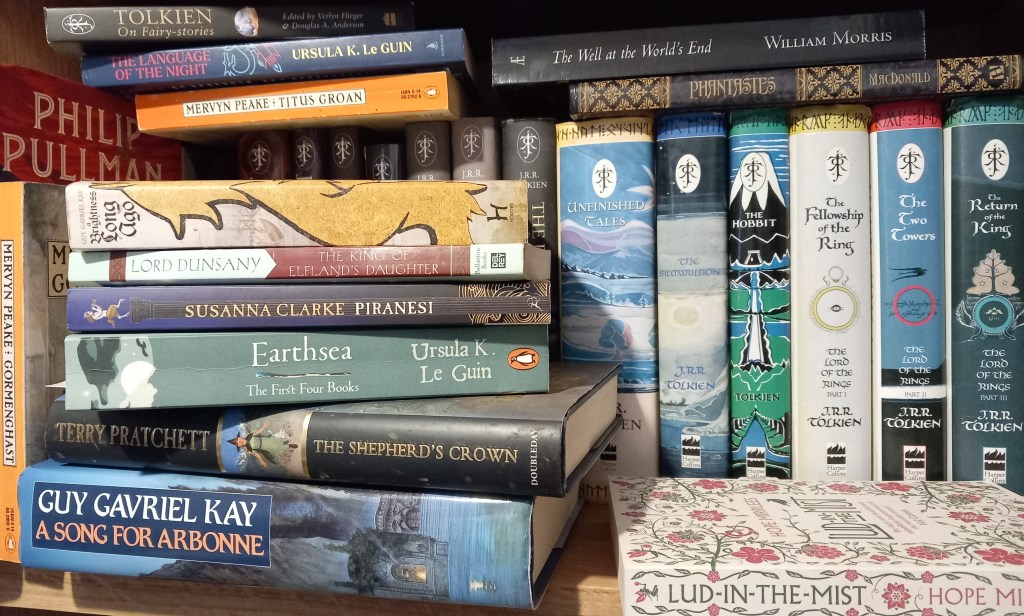
Yet fantasy can do anything. It can provide a setting to explore the most profound or disturbing themes. For me, I suspect, it is precisely the tool I need to rationalise my life and this world and what I make of it all. All fiction does this sort of thing, more or less, yet the secondary world of fantasy gives space to explore whatever one wishes, untrammelled by constraints of perception, or the history or the physics of this, our primary, world. As a landscape of beauty and profundity, I confess, I find fantasy unrivalled. It is imagination in service of revelation. So, I will end with a list of names, in no particular order, of some of those who have shown me, in the course of my reading adventure, how great and rich, and greatly varied, fantasy can be. JRR Tolkien, Susanna Clarke, Sir Terry Pratchett, Lord Dunsany, Ursula K Le Guin, Mervyn Peake, Angela Carter, Guy Gavriel Kay. I beg you set aside any lingering prejudice you may have and read their works with the attention they deserve. If you let them, they will take you on a journey, and you will never be quite the same again.
Copyright EPS James 2025
 Barnard Castle Writing Group