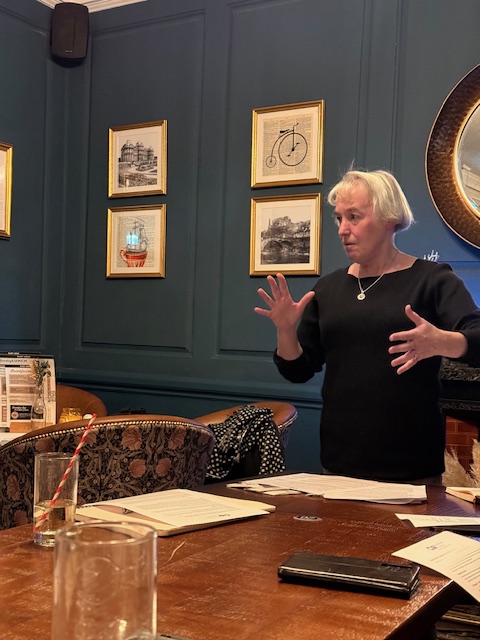
It was a dark, windy, and utterly miserable evening for our last BCWG evening, but the mood shifted the moment our writing group gathered. A last-minute venue change meant we found ourselves tucked upstairs in the function room at The Raby Arms, which turned out to be the perfect refuge for what would become a bright, lively and unexpectedly funny workshop. The session was led by the brilliant Dr Susan Mandela, PhD, of Writing Works Consulting, a friend of mine, and a gifted facilitator with a rare blend of academic insight, compassion and brilliant humour. Her workshop, Other Voices, promised to explore narrative viewpoint and linguistic nuance, but what unfolded was far more than a technical exercise, it became an evening of discovery and joint amusement at just how strange our everyday language really is.
We opened with an icebreaker, one of those deceptively simple tasks that exposes just how peculiar humans are. Each of us introduced ourselves (that wasn’t the peculiar bit…), said what genres we like to read and write, and then offered up a word we encounter every day that would be utterly baffling to an alien visitor.
Cue laughter. And confusion. And several moments of “oh, wow, our language really is ridiculous, isn’t it?”
Susan steered us through this with her trademark warmth, as we all revealed our examples reminding each of us how much meaning is assumed, implied or entirely dependent on invisible cultural context. It was a simple exercise, but it brought a much more relaxed feel to the evening and set the tone beautifully for what followed.
The heart of the evening centred on three carefully chosen excerpts from novels, none of which most of us had ever read before, which meant we encountered each passage cold, guided only by the text itself, allowing Susan to let us feel the way and prompt how language can reveal (or obscure) a character’s inner landscape.
We explored:
· how a single adjective can shift a character’s observation of their surroundings.
· how sometimes dialogue signals relationships long before plot does.
· how sparseness or flourish in prose can invite the reader into the world, and allow them to create the rest or lead them down a firm path.
At each stage, Susan challenged us to rewrite small sections from different viewpoints. Sometimes we added descriptive texture to see how it bent the emotional tone. Other times, we interjected connecting words to create a smoother read, use the tone and prescriptive language in various settings.
It was a masterclass in how flexible perspective can be, and how much narrative power lies in the subtle choices of language we often overlook.
Our last task was “free writing,” though that phrase was used loosely. We were offered three prompts:
1. Write a limerick
2. Rewrite a short narrative passage
3. Write a love poem from the perspective of The Borg
Yes — that Borg. The emotionless, hive-minded, cybernetic antagonists from Star Trek: The Next Generation. How could one resist?
I went for option three. I am, by nature, an emotional writer, so stepping into the circuitry of The Borg’s collective was quite a trying experience.
This is what I produced:
“I have assessed you for compatibility. It appears all is as it should be. And so we will marry tomorrow. In my wake, you will forever follow.”
Not my finest work, admittedly, but probably for the best. If I had found this exercise too easy, my friends and family might quite reasonably wonder whether I’ve been quietly assimilating their best qualities in preparation for my life as a Borg drone!
Other members produced wonderfully strange and funny poems of their own, and a couple of brilliant limericks that had us all grinning, and in awe.
We left The Raby Arms that night buzzing, not just from the creativity of the session, but from the way Susan had coaxed us into rethinking language entirely. In our minds rewriting scenes, reframing dialogues, questioning assumptions and generally turning our works-in-progress on their heads
‘Other Voices’ lived up to its title. It made us curious about tone, about perspective, about what happens when we let language stretch, twist and illuminate in unexpected ways.
We can’t thank Susan enough for her time, her expertise, and the energy she poured into the evening. Her workshop was a gift, one that left us seeing our stories, and the voices within them, a little differently. You can find out more about Susan on her website https://www.writingworksconsulting.co.uk/ and keep an eye out for some more workshops online and in-person. They really are well worth jumping in to.
 Barnard Castle Writing Group